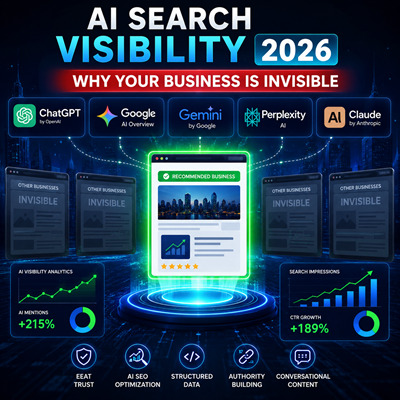
Zero-Click Search Is Here: How to Get Traffic When 58% of Searches Never Get a Click

Zero-Click Search Is Here: How to Get Traffic When 58% of Searches Never Get a Click

AI SEO

Zero-Click Search Is Here: How to Get Traffic When 58% of Searches Never Get a Click

Zero-Click Search Is Here: How to Get Traffic When 58% of Searches Never Get a Click

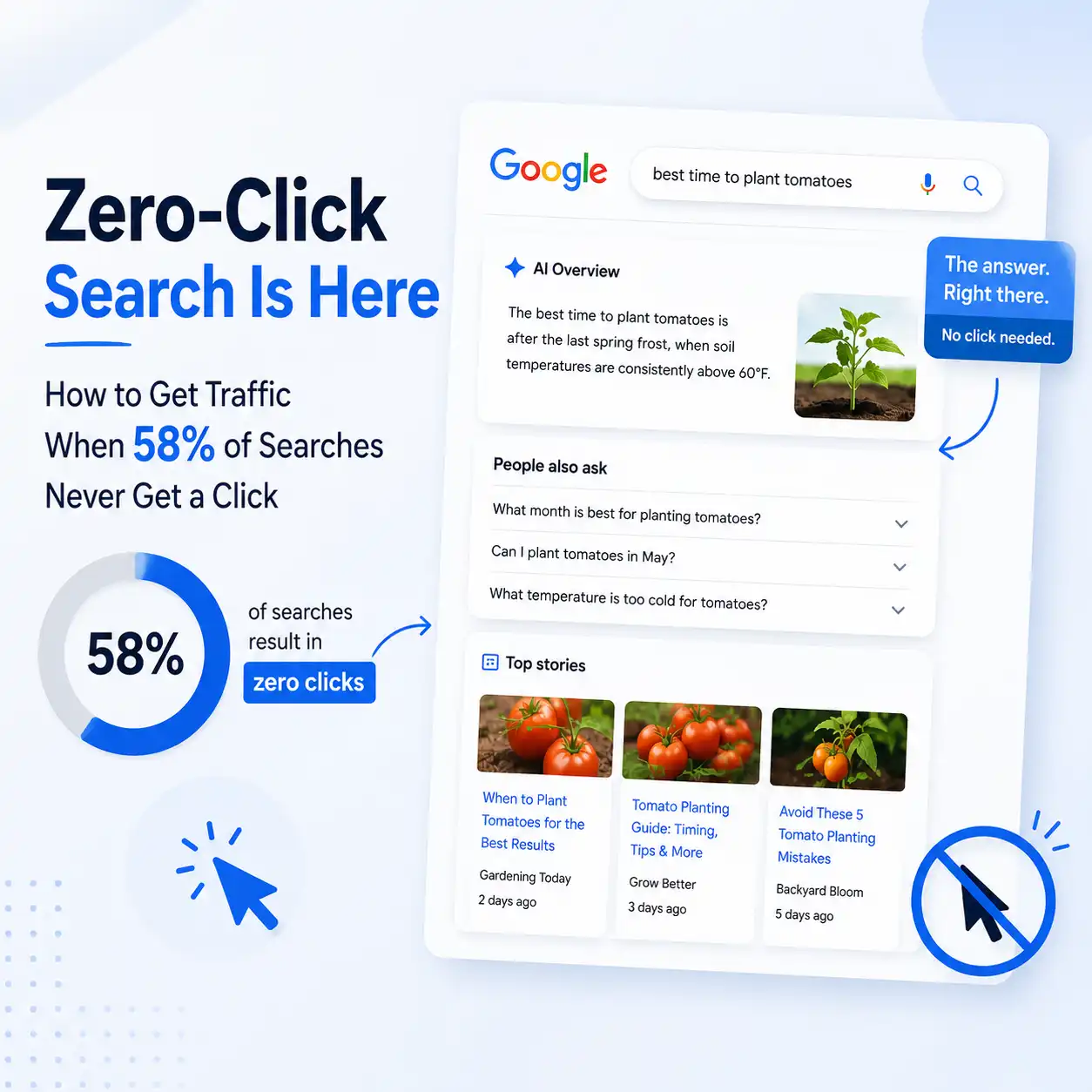
Type a question into Google today and there's a good chance you'll never click a single link. You'll read the answer right there on the results page and move on. That's a zero-click search, and it's no longer a rare outcome — it's the default. In the US alone, 58.5% of Google searches now end without a click to any website, and when an AI Overview shows up, that number jumps to roughly 83% (Arfadia, 2026). More recent tracking from SparkToro puts the broader zero-click rate even higher, at around 68% in early 2026 (Search Engine Land, 2026).

If you've noticed your rankings holding steady while your traffic quietly drops, this is why. It's not a penalty, and it's not something broken in your SEO. It's a structural shift in how search works — and it rewards a completely different set of tactics than the ones that got you ranked in the first place. This guide breaks down exactly what's happening, why it's accelerating, and what to actually do about it.

What Is a Zero-Click Search, Exactly?

A zero-click search is any query where the person gets their answer directly on the results page and never visits a website. Ask Google "how many teaspoons in a tablespoon" and it tells you instantly. Ask "current USD to INR rate" and a live converter appears. Ask a more complex question like "best CRM for a small team" and increasingly, an AI Overview summarizes the answer using content pulled from several sites — often without sending you to any of them.

This isn't new. Featured snippets and knowledge panels have been chipping away at click-through rates since around 2018. What's changed is the scale. Zero-click behavior has climbed steadily from roughly 50% of searches in 2019 to nearly 65% today, and AI Overviews have sharply accelerated that curve over the past 18 months (Digital Applied, 2026).

The Numbers: How Big Is the Zero-Click Shift in 2026

Here's the current data landscape, pulled from the most cited industry sources this year:

Metric Figure Source
US searches ending with zero clicks 58.5% – 68% SparkToro / Arfadia, 2026
Zero-click rate when AI Overview appears ~83% (93% in AI Mode) Bain & Company / Semrush, 2025–26
Mobile zero-click rate vs desktop 77% vs 46.5% Strategyc, 2026
Informational queries that go zero-click 74% Strategyc, 2026
Transactional queries that go zero-click Only 31% Strategyc, 2026
Organic CTR drop when AI Overview appears Roughly 58–61% Ahrefs / Amsive, 2025–26
Consumers relying on AI-generated answers for 40%+ of searches 80% Bain & Company, 2025

Two of these numbers matter more than the rest. First, the mobile vs desktop gap: if most of your audience searches on their phone, you're already living in the higher end of that zero-click range. Second, the informational vs transactional split: "how to" and "what is" content gets swallowed by AI Overviews far more often than "buy," "hire," or "near me" searches, which still overwhelmingly send clicks (Strategyc, 2026).

Why AI Overviews Are Speeding This Up

Featured snippets used to answer simple, single-fact questions. AI Overviews go further — they synthesize an answer from multiple sources into a few paragraphs, which satisfies far more of the questions people used to click through for. Google isn't the only one doing this. ChatGPT, Perplexity, and Gemini all resolve queries the same way, and AI assistants are expected to handle roughly a quarter of all global search-style queries this year (Squarespace SEO Trends, 2026).

The uncomfortable part: this isn't a temporary dip that reverses once the AI Overview novelty wears off. Bain & Company's research shows 80% of consumers now rely on AI-generated answers for at least 40% of their searches — this is becoming the normal way people search, not an edge case (Omnibound, 2026).

Zero-Click SEO vs Traditional SEO

Traditional SEO Zero-Click SEO (2026)
Success = ranking #1 for a keyword Success = being the source an AI answer cites
Metric: clicks and sessions Metric: impressions, brand mentions, AI citations
Content built to rank a page Content built to be quoted or extracted
Wins on backlinks and keyword density Wins on structured data, clarity, and topical authority
One-time optimization, then wait Continuous freshness — AI favors recently updated sources

The good news buried in this shift: even when users don't click, repeated exposure to your brand inside AI answers and SERP features still builds trust and drives conversions later in the buying journey (Semrush, 2026). You're not invisible. You're just being measured on a different scoreboard.

6 Ways to Actually Get Traffic in the Zero-Click Era

1. Write to Be Extracted, Not Just Ranked

AI Overviews and featured snippets pull from content that's already structured for extraction: a clear question as a heading, a direct 1–2 sentence answer immediately underneath, then supporting detail. Rambling intros and buried answers get skipped over — clarity gets cited (eDesign Interactive, 2026).

2. Go After Transactional, Not Just Informational Keywords

Since transactional searches ("hire," "buy," "get a quote near me") stay zero-click only 31% of the time versus 74% for informational queries, weighting your content strategy toward commercial-intent topics protects your actual traffic and leads (Strategyc, 2026).

3. Build Brand Search Demand

Branded keywords behave differently — Amsive's data found search terms containing a brand name actually gained click-through even when an AI Overview appeared, up nearly 19% (Clickforest, 2026). The more people search your business name directly, the less the zero-click trend affects you. Consistent content, PR mentions, and social proof all feed this.

4. Add Schema Markup Everywhere It Fits

Structured data (FAQ schema, Article schema, Product schema, LocalBusiness schema) is what makes your content machine-readable enough to be pulled into snippets, knowledge panels, and AI citations in the first place. Sites using structured data consistently see stronger visibility in SERP features (Digital Applied, 2026).

5. Own Your Google Business Profile and Local Signals

For service businesses, local zero-click results (map packs, knowledge panels) are where most visibility now happens. Keeping your profile updated with fresh photos, accurate hours, and active review responses directly increases how often you're the one Google recommends without a click (CS Web Solutions, 2026).

6. Track Different Numbers

If you're still judging content success purely by sessions and clicks, you're measuring the wrong thing. Impressions, SERP feature appearances, branded search volume, and AI citation frequency are now the leading indicators — and only about 1 in 5 marketers currently track AI visibility at all, which is a real competitive gap to fill (Averi.ai, 2026).

Zero-Click Content Checklist

Element Why It Matters
Question-based H2/H3 headings Matches how AI Overviews and voice search parse content
Direct answer in the first 1–2 sentences Gives AI/snippet engines something clean to extract
FAQ schema on every blog post Increases eligibility for rich results and AI citations
Author bio with real credentials Builds the E-E-A-T signal AI systems weigh heavily
Updated "last modified" dates AI systems favor recently refreshed sources
Branded, commercial-intent pages Keeps click-through where it still reliably happens

How This Connects to AI Search Visibility (GEO)

Optimizing for zero-click search and optimizing for AI search visibility are really the same job wearing two names. Getting cited inside an AI Overview or a ChatGPT answer requires the same structured, authoritative, freshly-updated content that ranks in traditional search — it's just measured by citations instead of clicks. We cover the technical side of this in detail in How to Make Your Website AI Search Friendly, including schema setup and content structure. And if you're a small business trying to compete with bigger names on top of this shift, How Small Businesses Can Use AI Automation to Compete With Big Brands shows how automation and AI visibility work together.

Ready to Rank for Clicks and Citations?

Zero-click search isn't going away — it's the new baseline. The businesses that win from here are the ones whose sites are fast, structured, and built to be the source AI systems trust enough to cite.

As a web development and SEO expert with 12+ years of experience, Ajay Maanju builds high-performance, AI-ready WordPress sites designed for both traditional rankings and AI search visibility.

Contact Now Visit AjayMaanju.com

Frequently Asked Questions

What is a zero-click search?

A zero-click search is a Google query where the user gets their answer directly on the results page — through a featured snippet, knowledge panel, or AI Overview — without clicking through to any website.

What percentage of searches are zero-click in 2026?

Roughly 58% to 68% of US Google searches now end without a click, and that rises to about 83% when an AI Overview appears on the results page (Arfadia, 2026; Search Engine Land, 2026).

Does zero-click search mean SEO doesn't work anymore?

No. It means the goal is shifting from clicks to visibility. Businesses that appear inside AI answers and SERP features still build brand trust and see stronger conversions once a click does happen — brands cited in AI Overviews convert visitors at meaningfully higher rates than average organic traffic.

How do I optimize my website for zero-click search?

Structure content around direct question-and-answer formats, add FAQ and Article schema, strengthen your author and business E-E-A-T signals, and prioritize commercial-intent keywords that still reliably drive clicks.

Which types of searches are least affected by zero-click results?

Transactional, commercial-intent searches like "hire a developer" or "buy [product] near me" stay zero-click only about 31% of the time, compared to 74% for general informational queries — meaning bottom-funnel content is your safest traffic source right now.

AM

Ajay Maanju — Web Development, SEO & AI Automation Expert

Ajay Maanju has 12+ years of experience helping small businesses build high-performance websites, AI automation systems, and AI-ready SEO strategies. He specializes in web development, mobile app development, technical SEO, and AI SEO & GEO optimization. Explore services at ajaymaanju.com →

How Small Businesses Can Use AI Automation to Compete With Big Brands

How Small Businesses Can Use AI Automation to Compete With Big Brands

AI SEO

How Small Businesses Can Use AI Automation to Compete With Big Brands

How Small Businesses Can Use AI Automation to Compete With Big Brands

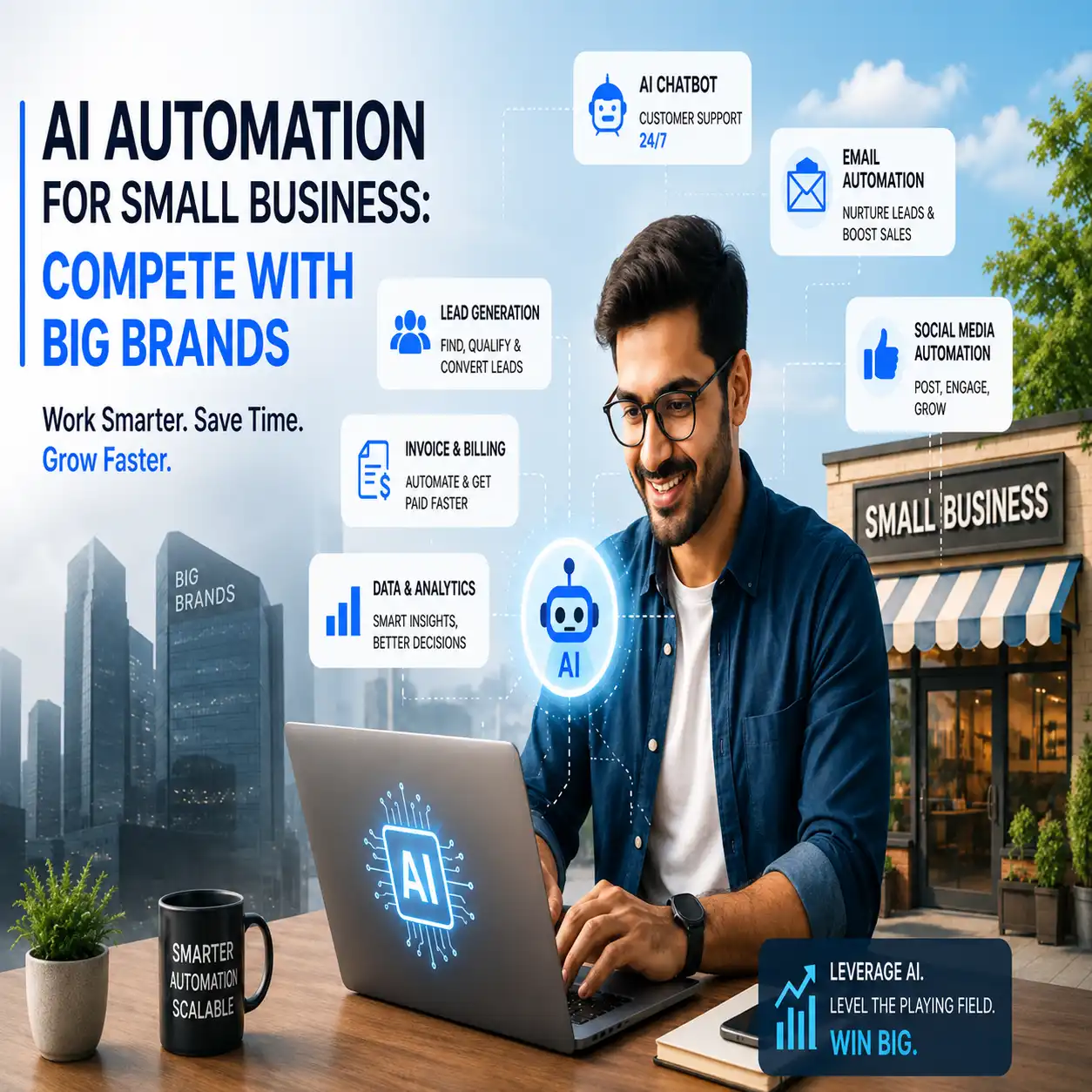
Big brands used to win on budget alone — bigger ad spend, bigger teams, bigger software stacks. That gap is closing fast. AI automation for small business now makes it possible for a two-person shop to respond to leads, run marketing, and support customers with the same speed and consistency as a company 50 times its size. Small firms are adopting AI faster than any technology cycle before it — one 2026 analysis notes that unlike past shifts such as broadband, small businesses are closing the gap with large enterprises in months instead of years, largely because free tools like ChatGPT, Claude, and Gemini removed the cost barrier (AdAI, 2026). This guide shows exactly where to apply AI automation first, what results to expect, and how to avoid the mistakes that keep most small businesses stuck at the "experimenting" stage.

Why AI Automation Is the Great Equalizer for Small Business

Big brands compete on scale — more staff answering calls, more budget for ads, more tools stitched together by IT teams. AI automation removes that advantage because a single owner-operated business can now run the same core functions — lead response, follow-up, content, and reporting — without hiring for them.

The adoption data backs this up: small businesses using generative AI jumped from 23% in 2023 to 58% in 2025, a near-tripling in two years (U.S. Chamber of Commerce, 2025). Growth and AI adoption are also directly linked — growing small businesses are 83% likely to have adopted AI, compared to just 55% of declining businesses, and 78% of growing SMBs plan to keep increasing that investment (AdAI, 2026). Interestingly, it's not the mid-sized firms leading the charge — the very smallest businesses, under five employees, over-index on AI use, treating it as their first "hire" (U.S. Census Bureau / SBA, 2025).

1. Instant Lead Response: Win the Deal Before Big Brands Reply

Big brands are often slower to respond simply because of internal process. Small businesses that automate their first response can beat them to the sale every time — 78% of customers hire whichever company responds first when comparing service providers (DeanTek, 2026).

✅ Where to apply it:

  • AI chat widgets that qualify and route leads instantly, 24/7
  • Missed-call text-back automation for phone-based businesses
  • SMS follow-up sequences — SMS response rates average 45%, versus roughly 6% for email, making it the highest-engagement channel for time-sensitive offers

2. AI-Powered Marketing: Produce Like an Agency, Spend Like a Solo Founder

Content creation is the single largest AI use case for small business, and marketers are all-in on it: 94% of marketers plan to use AI in their content creation process, with content creation, data analysis, and workflow automation as the three leading applications (HubSpot State of Marketing, 2026). Marketing automation also delivers some of the most consistently validated ROI in the category — 77% of marketers report higher conversion rates after adopting it (DeanTek, 2026).

🔥 Practical wins for small teams:
  • AI-assisted blog and social content, repurposed across channels from a single brief
  • Automated email/SMS nurture sequences replacing manual follow-up
  • AI-generated ad variations tested automatically for performance

3. Customer Service Automation: Cover the Hours You Never Staffed

A chatbot or AI voice agent doesn't need to replace a team member — it just needs to cover the after-hours and overflow inquiries no one was answering anyway. That's why AI-powered customer service consistently shows strong returns: businesses report $3.50 in returns for every $1 invested in AI-powered customer service systems (multiple analyst estimates, 2025, via DeanTek). More broadly, 91% of small businesses using AI report measurable revenue increases, and small businesses using AI are 2.3x more likely to report revenue growth than non-users (Salesforce / U.S. Chamber of Commerce, 2025–2026).

4. Back-Office Automation: Reclaim the Hours Big Brands Pay Staff For

Big brands throw headcount at admin work — invoicing, scheduling, reporting, data entry. Small businesses can automate the same tasks directly.

High-impact areas:

  • Automated invoicing, reminders, and reconciliation
  • AI-assisted scheduling and appointment confirmations
  • Auto-generated performance reports and dashboards

Marketing, customer service, and administrative work remain the top three reported AI use cases among small businesses — the common thread being work a small team simply can't keep up with manually (Intuit QuickBooks Small Business Insights, 2025).

Where Small Businesses Are Still Falling Behind

Adoption is high, but strategy is thin. Only 8% of businesses reach advanced AI adoption levels, with most still testing one or two use cases without a broader plan (Salesforce SMB Trends Report, 2024). 77% of small businesses using AI have no formal prompting strategy or system, and only 23% have received any formal training on the tools they use (Aufsite Research / Booth Associates, 2026). This is the gap that separates businesses getting a real competitive edge from businesses that just "tried ChatGPT once."

Traditional Operations vs AI-Automated Small Business

Traditional Small Business AI-Automated Small Business
Leads answered during business hours only Leads qualified and routed 24/7
Manual follow-up emails, often delayed Automated SMS/email sequences within minutes
Content created ad hoc, inconsistently AI-assisted content produced on a repeatable schedule
Admin work absorbs owner's time Invoicing, scheduling & reporting run automatically
Growth capped by hours in the day Growth capped only by strategy and demand

AI Automation Checklist for Small Businesses

Business Function What to Automate First
Lead response Chat widget + missed-call text-back
Marketing AI content drafts + automated email/SMS nurture
Customer service FAQ chatbot for after-hours & repetitive queries
Sales follow-up CRM automation with AI-scored leads
Operations Invoicing, scheduling & reporting automation

How This Connects to AI Search Visibility (GEO)

Automating your operations is only half the equation — AI models like ChatGPT, Gemini, and Google AI Overviews also need to be able to find and recommend your business in the first place. We cover exactly how to structure your website for that in our companion guide, How to Make Your Website AI Search Friendly, which walks through schema markup, EEAT signals, and AI-readable content structure. Together, automation and AI-search visibility are what let a small business look — and perform — like a big brand.

Ready to Automate Your Small Business Like a Big Brand?

Competing with big brands isn't about matching their budget — it's about matching their speed and consistency using AI automation, high-performance websites, and AI-ready SEO built specifically for how your business operates.

As a web development, SEO, and AI automation expert with 12+ years of experience, Ajay Maanju helps small businesses build automated, AI-visible systems that punch above their size.

Contact Now Visit AjayMaanju.com

Frequently Asked Questions

What is AI automation for small business?

It's the use of AI tools — chatbots, automated marketing sequences, CRM scoring, and back-office automation — to handle repetitive tasks so a small team can operate with the speed and consistency of a much larger company.

Can small businesses really compete with big brands using AI?

Yes. Adoption data shows small businesses closing the technology gap with large enterprises in months rather than years, largely due to free and low-cost AI tools removing the traditional cost barrier to automation (AdAI, 2026).

Where should a small business start with AI automation?

Start with lead response and customer service automation — they have the fastest, most measurable ROI, since they cover hours and inquiries the business was never staffed to handle manually.

Does AI automation help with SEO and AI search visibility too?

Yes, indirectly. Consistent, automated content and customer engagement builds the authority and structured data signals that AI search engines look for — see our guide on making your website AI search friendly for the technical steps.

AM

Ajay Maanju — Web Development, SEO & AI Automation Expert

Ajay Maanju has 12+ years of experience helping small businesses build high-performance websites, AI automation systems, and AI-ready SEO strategies. He specializes in web development, mobile app development, technical SEO, and AI SEO & GEO optimization. Explore services at ajaymaanju.com →

How to Make Your Website AI Search Friendly

How to Make Your Website AI Search Friendly

AI SEO

How to Make Your Website AI Search Friendly

How to Build an AI Search Friendly Website

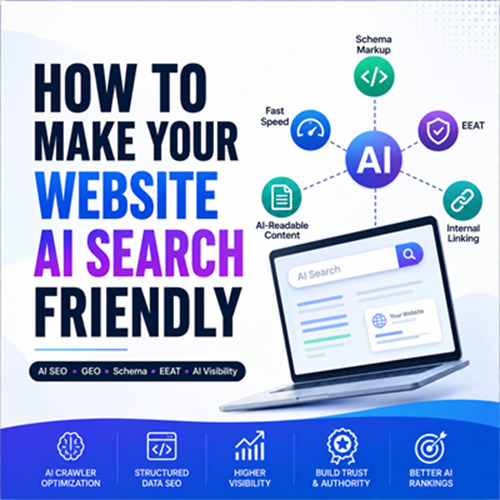
In 2026, ranking on Google's first page is no longer the finish line. ChatGPT, Gemini, Perplexity AI, and Google AI Overviews now decide which businesses get recommended directly inside a conversation. If your website isn't built to be understood by these systems, you simply won't be cited — no matter how good your content is. Building an AI search friendly website means combining structured data SEO, technical performance, and strong EEAT signals so AI crawlers can read, trust, and recommend your business. This guide shows you exactly how to make your AI search friendly website checklist a reality.

This guide breaks down exactly how to make your site AI-ready, step by step.

Why "AI-Ready SEO" Is Different From Traditional SEO

Traditional SEO is built around keywords and backlinks. AI search engines work differently — they extract facts, summarize entities, and verify trust before quoting a source. That's why an AI-ready SEO strategy has to focus on clarity, structure, and verifiable authority rather than keyword density alone.

We covered the core reasons businesses disappear from AI results in our earlier guide, Why Your Business Is Not Showing in ChatGPT & Google AI Results — this post picks up where that one left off and shows you exactly what to fix.

1. Schema Markup: Speak the Language AI Understands

AI crawlers don't "read" a page the way humans do — they parse structured data to understand what a page is about. Without schema optimization, even great content can be misread or ignored.

✅ Schema types every AI-friendly website needs:

  • Organization schema (business name, logo, contact details)
  • Article / BlogPosting schema
  • FAQ schema
  • Breadcrumb schema
  • Author schema with credentials
  • Product or Service schema (for businesses selling online)

Adding clean, validated schema is one of the fastest ways to turn raw content into machine-readable facts that AI systems can confidently cite.

2. Fast Website Speed: AI Crawlers Don't Wait

Page speed has always mattered for SEO — but it matters even more for AI crawler optimization. AI bots crawl thousands of pages quickly; slow-loading, render-heavy sites often get skipped or only partially indexed.

🔥 Speed checklist:
  • Compress and lazy-load images
  • Use a lightweight, caching-enabled hosting setup
  • Minify CSS/JS and remove unused scripts
  • Serve content with a CDN
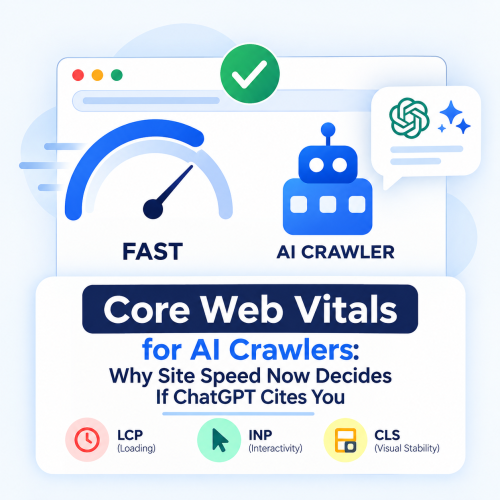
  • Keep Core Web Vitals (LCP, CLS, INP) in the "good" range

A fast site doesn't just rank better — it gets fully crawled, which is the first requirement for AI visibility.

3. EEAT: The Trust Layer AI Search Relies On

Google and AI models both lean heavily on Experience, Expertise, Authority, and Trustworthiness (EEAT) to decide which sources are safe to recommend.

EEAT signals to strengthen:

  • Real author bios with credentials and experience
  • Original case studies and data, not generic AI-written content
  • Genuine testimonials and reviews
  • Transparent contact and business information
  • Regularly updated, fact-checked content

Weak EEAT is one of the most common reasons businesses stay invisible in AI answers — it's worth auditing this before anything else.

4. AI-Readable Content: Write for Extraction, Not Just Ranking

AI systems extract short, direct answers from content — so your structure matters as much as your writing. AI-readable content is scannable, conversational, and broken into clear, answerable chunks.

How to structure AI-readable content:

  • Open sections with a direct, question-style heading
  • Answer the question in the first 1–2 sentences
  • Use bullet points and short paragraphs over long blocks of text
  • Add a dedicated FAQ section using natural, spoken-language questions
  • Avoid fluff — AI models reward clarity over word count

5. Internal Linking: Build Topical Authority AI Can Follow

Strong internal linking helps AI crawlers understand how your content connects, which topics you're authoritative on, and which pages carry the most weight. Every related article should link to and from your core AI SEO content — for example, this guide builds directly on Why Your Business Is Not Showing in ChatGPT & Google AI Results, creating a topic cluster AI systems can map and trust.

Internal linking best practices:

  • Link between related, in-depth articles (not just the homepage)
  • Use descriptive, keyword-relevant anchor text
  • Group content into topic clusters (e.g., "AI SEO," "Technical SEO," "EEAT")
  • Keep important pages within 2–3 clicks of the homepage

AI Website Optimization Checklist

AI Visibility Factor What to Fix
Schema markup Add Organization, Article, FAQ & Author schema
Website speed Optimize images, hosting & Core Web Vitals
EEAT signals Add real author bios, case studies, reviews
AI-readable content Short answers, FAQs, conversational headings
Internal linking Connect related articles into topic clusters
Structured data SEO Validate markup with Google's Rich Results Test

Traditional SEO vs AI-Ready SEO

Traditional SEO AI-Ready SEO / GEO
Focus on rankings Focus on AI visibility & citations
Keyword density Conversational, extractable answers
Backlinks Authority, EEAT & verified facts
Meta tags only Full schema markup + structured data

Need an AI Search Friendly Website?

Making a website AI-ready takes more than installing an SEO plugin — it requires schema optimization, performance tuning, EEAT-focused content, and a deliberate internal linking strategy.

As a web development and SEO expert with 12+ years of experience, Ajay Maanju helps businesses build AI-ready websites that show up inside ChatGPT, Google AI Overviews, and Gemini results.

Contact Now Visit AjayMaanju.com

Frequently Asked Questions

What does it mean to make a website AI search friendly?

It means structuring your site with schema markup, fast performance, strong EEAT signals, and clear, extractable content so AI search engines like ChatGPT and Google AI Overviews can read, trust, and recommend it.

Does schema markup really help with AI search visibility?

Yes. Schema gives AI crawlers structured, unambiguous facts about your business, content, and authorship — making it far easier for them to cite your site accurately.

How important is website speed for AI crawler optimization?

Very important. Slow or render-heavy pages risk incomplete crawling, which means AI systems may never fully index your content in the first place.

Is EEAT a ranking factor for AI search engines too?

Yes. EEAT (Experience, Expertise, Authority, Trustworthiness) is one of the strongest signals both Google and AI models use to decide which sources are safe to recommend.

AM

Ajay Maanju — Web Development, SEO & AI SEO Expert

Ajay Maanju has 12+ years of experience helping businesses build scalable, AI-ready websites. He specializes in high-performance web development, mobile app development, technical SEO, and AI SEO & GEO optimization. Explore services at ajaymaanju.com →

Why Your Business Is Not Showing in ChatGPT & Google AI Results

Why Your Business Is Not Showing in ChatGPT & Google AI Results

AI SEO, WordPress

Why Your Business Is Not Showing in ChatGPT & Google AI Results

Why Your Business Is Not Showing in ChatGPT & Google AI Results

Businesses are investing heavily in SEO, websites, and digital marketing — yet many still do not appear inside ChatGPT, Google AI Overviews, Gemini, Claude, or Perplexity AI results. In 2026, traditional SEO alone is no longer enough. Modern businesses now need AI SEO and Generative Engine Optimization (GEO) strategies to improve AI visibility, citations, authority, and future search rankings. If your business is invisible in AI-generated search results, you are already losing future customers and leads.

The Biggest Shift in Search Has Already Started

Search behavior is changing rapidly. Instead of typing short keywords into Google, users now ask AI tools complete questions like:

  • Best Shopify developer for startups
  • Top AI automation company
  • Affordable website expert near me
  • Best SEO agency for eCommerce

Platforms like ChatGPT, Google Gemini, Perplexity AI, Claude AI, and Microsoft Copilot now generate direct answers instead of simply displaying website links.

Why Your Business Is Not Showing in AI Search Results

Most websites are still optimized only for traditional search engines. AI systems work differently.

✅ Common Reasons Businesses Stay Invisible in AI Results

  • Weak EEAT signals
  • Generic AI-generated content
  • No author authority
  • Poor website structure
  • Missing FAQ schema
  • Weak topical authority
  • No conversational SEO optimization
  • No AI-focused content strategy
  • Low brand mentions online
  • Outdated technical SEO

What Is AI SEO & GEO Optimization?

Traditional SEO focuses on ranking pages.

AI SEO focuses on helping AI systems understand, trust, and recommend your business.

This process is called Generative Engine Optimization (GEO).

GEO helps businesses improve visibility inside:

  • ChatGPT answers
  • Google AI Overviews
  • AI-generated recommendations
  • Conversational search systems

How AI Systems Decide Which Businesses to Recommend

AI Visibility Factors Importance
EEAT signals Very High
Structured content High
Brand authority High
Schema markup High
Technical SEO Medium

Why EEAT Matters More Than Ever in 2026

Google and AI systems prioritize:

  • Experience
  • Expertise
  • Authority
  • Trustworthiness

This is known as EEAT.

🔥 EEAT Optimization Tips:
  • Add expert author information
  • Show years of experience
  • Add real case studies
  • Display testimonials
  • Use original screenshots
  • Keep content updated regularly
  • Add structured FAQ sections

Real AI Visibility Case Study

A Shopify business approached us because their website traffic was stable, but they were getting almost no qualified leads from AI-powered search systems.

After auditing the website, we found major issues:

  • Weak EEAT signals
  • Generic blog structure
  • Missing schema markup
  • Poor internal linking
  • No AI-focused content

📈 Results After 90 Days

  • Organic Traffic41% increase
  • Lead QualityBetter & more qualified
  • AI VisibilityHigher appearance rate
  • Google AI OverviewImproved presence
  • User EngagementBetter overall metrics

How to Make Your Website AI Search Friendly

✅ AI Website Optimization Checklist

  • Add FAQ sections
  • Improve page speed
  • Use schema markup
  • Create topical authority clusters
  • Add author expertise
  • Use conversational headings
  • Improve internal linking
  • Publish long-form expert content
  • Keep content updated
  • Build brand mentions online

Traditional SEO vs AI SEO

Traditional SEO AI SEO / GEO
Focus on rankings Focus on AI visibility
Keywords Conversational relevance
Search engines AI answer engines
Backlinks Authority + trust

Need Help Improving Your AI Visibility?

Building an AI-ready website requires more than traditional SEO. Businesses now need AI SEO strategies, GEO optimization, EEAT improvements, structured content, and conversational optimization to appear inside ChatGPT and Google AI results.

As a web development and Shopify expert with 12+ years of experience, Ajay Maanju helps businesses create AI-ready websites optimized for future AI search systems.

Contact Now Visit AjayMaanju.com

Frequently Asked Questions

Why is my business not showing in ChatGPT?

Your website may lack EEAT signals, structured content, conversational SEO optimization, schema markup, or sufficient online authority.

What is Generative Engine Optimization (GEO)?

GEO is the process of optimizing websites for AI-powered search engines like ChatGPT, Google AI Overviews, Gemini, and Perplexity AI.

Is traditional SEO enough in 2026?

No. Businesses now need both traditional SEO and AI SEO strategies to remain visible in modern AI-powered search systems.

How can I improve AI search visibility?

Improve EEAT signals, add FAQ sections, build authority mentions, optimize technical SEO, and create conversational expert-level content.

AM

Ajay Maanju — Shopify, WordPress, and AI SEO Expert

Ajay Maanju has 12+ years of experience helping businesses build scalable, AI-ready websites. He specializes in Shopify and WordPress Development, AI SEO & GEO Optimization, Technical SEO, and Website Performance. Explore services at ajaymaanju.com →